
 Up to Topics
 Previous
 Next
NextRelationship to Convolution
Suppose an LTI system has impulse response h(n) and frequency response H(ω ). We have seen that if the input to this system is ejω n, then the output is H(ω )ejω n. Suppose the input is instead a signal x with DTFT X. Using the inverse DTFT relation, we know that for all n,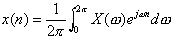 .
.View this as a summation of exponentials, each with weight X(ω ). An integral, after all, is summation over a continuum. Each term in the summation is X(ω )ejω n. If this term were an input by itself, then the output would be H(ω )X(ω )ejω n. Thus, by linearity, if the input is x, the output should be
 .
.Comparing to the inverse DTFT relation for y(n), we see that
This is the frequency-domain version of convolution