
 Up to Topics
 Previous
 Next
NextFunction composition
If f1: X → Y and f2: X' → Y', and Y is a subset of X', then the composition of f1 and f2 is the function f3: X → Y' such that
The function f3 has the same effect as first applying f1, then applying f2, as shown below:
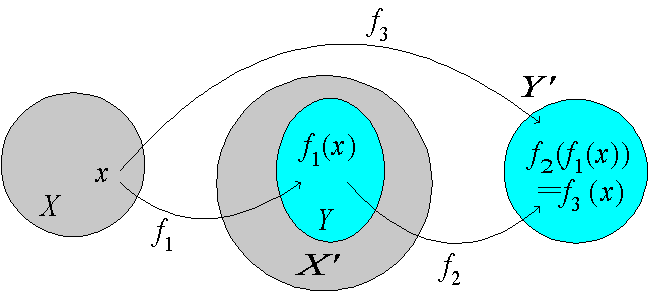
- The function f3 is written f3 = f2 · f1
- Note that f1 is applied first, despite being to the right of f2.
- If the domain and the range of a function are the same, i.e. f: X → X, then f 2 = f · f, f 3 = f 2 · f, …
The telephone network is a function
A modem receiver is a function
Ideally, a modem design is a function such that
where Identity: BitSequences → BitSequences is an identity function, where
The challenge, of course, is to come up with a design that satisfies this property for a wide range of functions TelephoneNetwork.