
 Up to Topics
 Previous
 Next
NextFourier series coefficients
Consider an audio signal given by
This is a major triad in a non-well-tempered scale. The first tone is A-440. The third is approximately E, with a frequency 3/2 that of A-440. The middle term is approximately C sharp, with a frequency 5/4 that of A-440. It is these simple frequency relationships that result in a pleasant sound. We choose the non-well-tempered scale because it makes it much easier to construct a Fourier series expansion for this waveform.
To construct the Fourier series expansion, we can follow these steps:
- Find p, the period. The period is the smallest number p such that s(t) = s(t − p). To do this, note that
- Find A0, the constant term. By inspection, there is no constant component in s(t), only sinusoidal components, so A0 = 0.
- Find A1, the fundamental term. By inspection, there is no component at 110 Hz, so A1 = 0.
- Find A2, the first harmonic. By inspection, there is no component at 220 Hz, so A2 = 0.
- Find A3. By inspection, there is no component at 330 Hz, so A3 = 0.
- Find A4. There is a component at 440 Hz, sin(440× 2π t). We need to find A4 and φ 4 such that A4cos(440× 2π t +φ 4) = sin(440× 2π t). By inspection, φ 4 = - π /2 and A4 = 1.
- Similarly determine that A5 = A6 = 1, φ 5 = φ 6 = - π /2, and all other terms are zero.
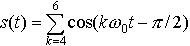
where ω 0 = 220π.
Clearly this method for determining the Fourier series coefficients is tedious and error prone, and will only work for simple signals. We will see much better techniques.
Exercise
Determine the fundamental frequency and the Fourier series coefficients for the well-tempered major triad,