
 Up to Topics
 Previous
 Next
NextTelephony
Ubiquitous worldwide voice communication is certainly one of the major engineering triumphs of the twentieth century. Recall that voiceband data modems exploit this network to achieve worldwide digital communication. Using a notebook computer with a built-in modem, you can connect to the internet anywhere in the world that you can get access to a phone wire.Recently, the telephone network has been freeing itself of its dependence on wires. Cellular telephones, which came into widespread use in the 1990s, use radio waves to connect a small, hand-held telephone to a nearby base station. The base station connects directly to the telephone network. Cordless telephones use the same concept, but unlike cordless telephones, cellular telephones are designed to communicate with whatever base station is closest, rather than with one particular base station.
There are three major challenges in the design of cellular networks.
- First, radio spectrum is scarce (see the sidebar on radio spectrum). Frequencies are allocated by regulatory bodies, often constrained by international treaties. Finding frequencies for new technologies is difficult. Thus, wireless communication devices have to be extremely efficient in their use the available frequencies.
- Second, power is limited. Human considerations require that cellular phones operate for reasonably long periods of time using only small batteries that fit easily within the handset. Although battery technology has been improving, the power that these batteries can deliver severely limits the range of a cellular phone (how far it can be from a base station) and the processing complexity (the microprocessors in a cellular phone consume considerable power).
- Third, networking is complicated. In order to be able to route telephone calls to a cellular phone, the network needs to know where the phone is (or more specifically, which base station is closest). Moreover, the network needs to support phone calls in moving vehicles, which implies that a phone may move out of range of one base station and into the range of another during the course of a telephone call. The network must "hand off" the call seamlessly.
This fourth-power propagation loss was traditionally considered only to be a hindrance to wireless communication. It had to be overcome by greatly boosting the transmitted power. The cellular concept turns this hindrance into an advantage. It observes that since the loss is so high, beyond a certain distance the same frequencies can be re-used without significant interference. Thus, the service area is divided into cells idealized below:
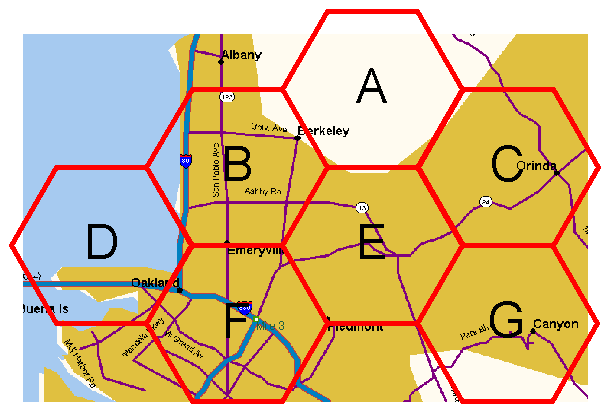
In this (hypothetical) picture, the Berkeley campus is served by a base station in area A. Downtown Berkeley is in area B. These two base stations must coordinate a "hand off" when someone riding the BART shuttle from downtown Berkeley to the Berkeley campus is using their cellular phone. Emeryville (area F) can re-use the frequencies used in area A because the propagation loss is sufficient that telephone conversations in area A will not interfere with conversations in area F.
A second benefit of the cellular concept is that, at least in urban areas, a cellular phone is never far from a base station. Thus, it does not need to transmit a high-power radio signal to reach a base station. This makes it possible to operate on a small battery.
Ideally, a cellular phone, with its one phone number, could be called anywhere in the world, wherever it happens to be, without the caller needing to know where it is. Unfortunately, the technological and organizational infrastructure is not quite there yet. When a phone "roams" out of its primary service area, it has to negotiate with the service provider in a new area for service. That service may be incomplete, for example allowing outgoing but not incoming calls. Charges may be exorbitant, and technical glitches may prevent smooth operation.
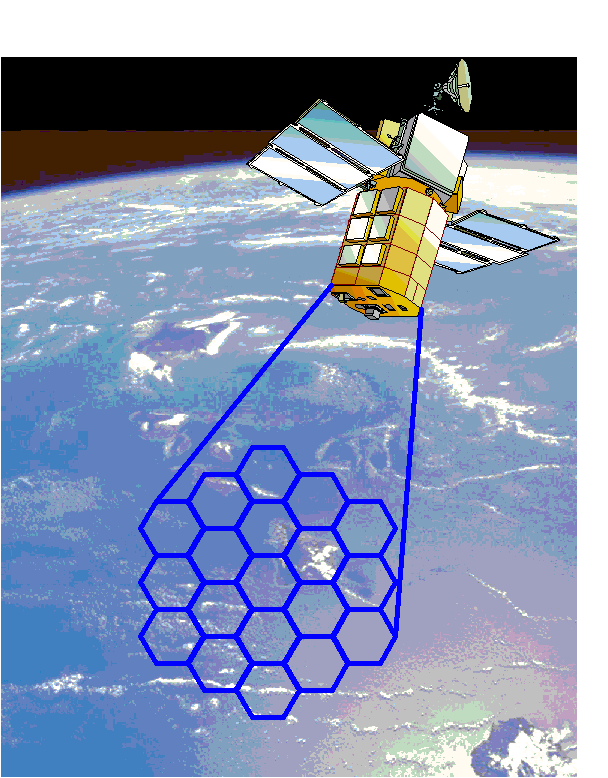
One candidate technology for solving these problems is a suite of global telephony services based on low-earth-orbit (LEO) satellites. One such project (now bankrupt) is the Iridium project, spearheaded by Motorola, and so named because in the initial conception, there would be 77 satellites. The iridium atom has 77 electrons. The idea is that enough satellites are put into orbit that one is always near enough to communicate with a hand-held telephone. When the orbit is low enough that a hand-held telephone can reach the satellite (a few hundred kilometers above the surface of the earth), the satellites move by fairly quickly. As a consequence, during the course of a telephone conversation, the connection may have to be handed off from one satellite to another. In addition, in order to be able to serve enough users simultaneously, each satellite has to re-use frequencies according to the cellular concept. To do that, it focuses multiple beams on the surface of the earth, as suggested by the following (somewhat schematic) picture:
There is some debate about whether this approach is economically viable.
The investment already has been huge, so the risks are high. Better networking
of terrestrial cellular services may provide formidable competition. The
LOS approach, however, has one advantage that terrestrial services cannot
hope to match: truly worldwide service. The satellites are expected to
provide service essentially everywhere, even in remote wilderness areas
and at sea.
Digital Voice
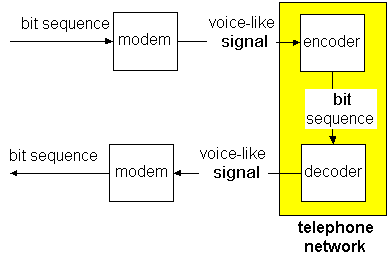
Ironically, although telephony networks are designed to carry voice signals, they are almost entirely digital. Recall that modems enable such voice networks to carry streams of bits. To do so, they encode the streams of bits as audio signals with roughly the same technical characteristics as voice signals. We have ended up with a rather peculiar design, where bit streams are converted to voice-like signals and launched into a network that converts them back to (rather different) bit streams for transport. At the far end, these bit streams are converted back to audio signals, and the modem receiver then converts them back to bit streams again.
This strange design evolved. There has been progress to correct this by providing end-to-end digital service. The first such effort (in the sense of attempting to reach the largest number of customers), is ISDN (integrated-services digital network), which is now largely obsolete. In ISDN, the bit stream in the telephone network is made available at the endpoint, at the customer site. However, ISDN was designed 10 years before the internet took off, and due to sluggish market demand, was only very slowly introduced. As a result, by the time it was really needed (for internet access), it was old technology that barely outpaced voiceband data modems.
Today, there are two options, DSL and cable modems. "DSL," which stands for digital subscriber line, is similar to ISDN in principle, but with much higher speed access. Cable modems use the cable TV infrastructure instead of telephone lines to get to the customer site. The same cable is shared by many users (and of course, by cable TV broadcast). DSL uses the same telephone lines that already connect telephones to the central office, but replaces the line card at the central office. In both cases, a modem is needed at the customer site.